
DPDP Ledger
DPDP compliance, made operational.
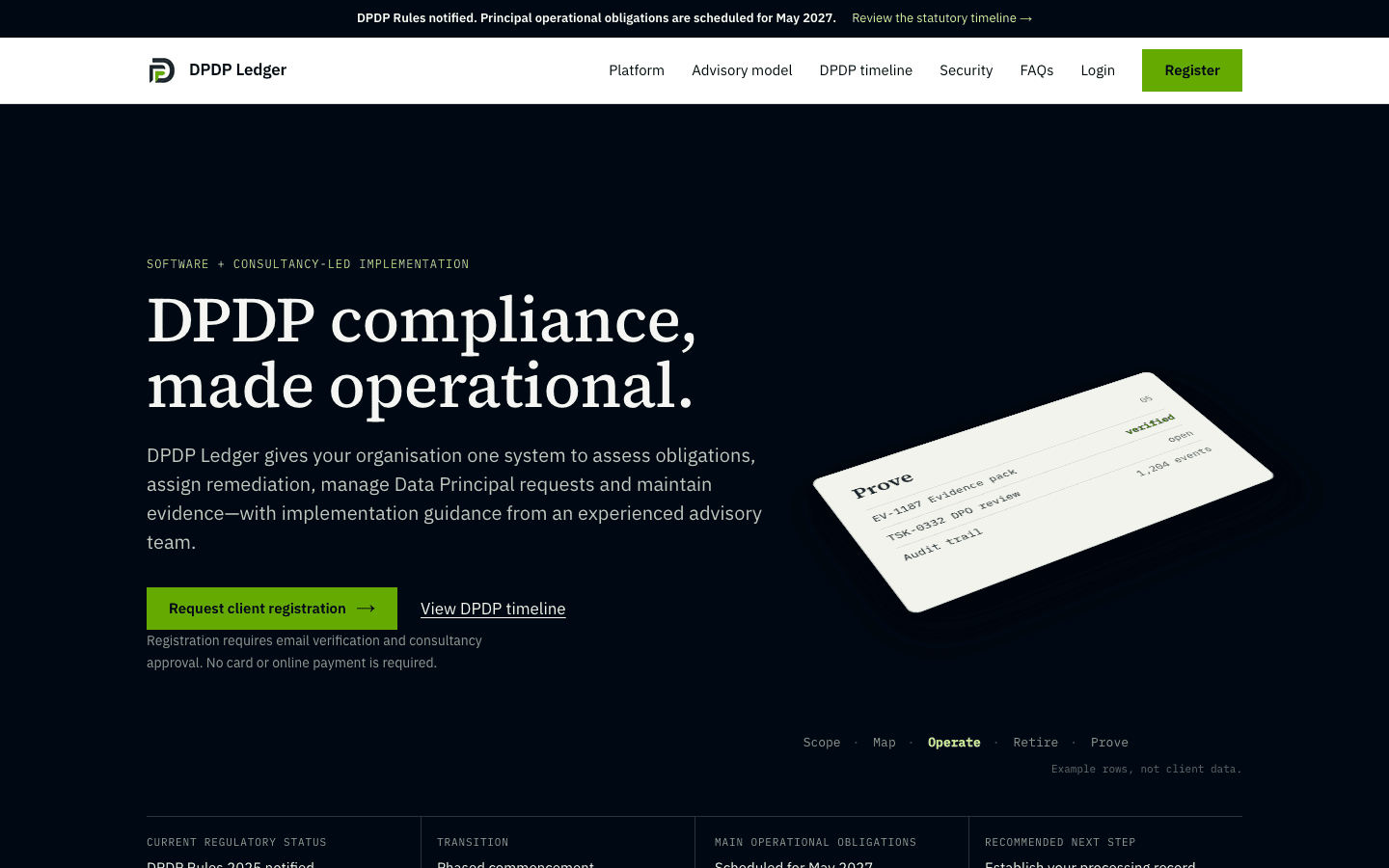
The problem
India's DPDP Rules were notified in November 2025 and the main operating obligations commence in May 2027. Most organisations know the Act applies to them but not which controls belong to which system or owner. Their evidence sits in inboxes and shared drives, and rights requests and breaches arrive in a mailbox with no clock attached.
What we built
- Applicability assessment
- Processing register
- Controls, tasks and evidence
- Rights and grievance workflows
- 72-hour breach response
- Append-only audit trail
Scope and map
Know what applies, and to which system.
A versioned applicability assessment recommends the control domains in scope. The processing register records every activity, system, processor, purpose and transfer, with a named owner on each.
- Versioned applicability
- Processing activities and systems
- Processors and cross-border transfers
- Significant Data Fiduciary status
Controls and evidence
Every obligation has an owner and a dated record.
Applicable obligations become owned tasks and recurring controls. Evidence is versioned and scanned before review, and every consultancy review decision lands in an append-only audit trail.
- Control register with review status
- Versioned evidence repository
- Governed risk acceptance
- Tamper-evident history
Overview
Today
Controls in scope
42 of 58
Open rights requests
7
Evidence items
312
Audit events
1,204
Last 7 days
Rights and breaches
Requests and incidents run on a clock, not an inbox.
Access, correction, erasure and nomination requests carry per-type deadlines and labelled clarification pauses. Breach cases keep the original awareness timestamp and track affected-party intimation separately from the 72-hour detailed report.
RR-0193 Access request
Rights request
INC-0412 Breach notice
Incident
CR-2291 Consent withdrawn
Consent
TSK-0332 DPO review
Task
Advisory model
Technology keeps the record. Professionals guide the work.
Clients register, verify their email and are approved by the consultancy before a workspace is created. An assigned advisory team takes them from scoping to an operating programme, and reviews the evidence along the way.
Integrations
Keep the register in sync with the systems it describes.
A versioned API lets client systems sync processing activities, systems, processors and records, with scoped keys, IP allowlists, rate limits and idempotent writes.
Have an idea like DPDP Ledger? We take it live in 10 days.
Any complexity, one fixed price, same-day delivery discussed on the call. Book a 30–90 minute session with our AI experts.
Other live products